How to recruit high-quality sub-partners as a Deriv Master Partner
Learn how to attract direct sub-partners through your Deriv Master Partner link, use effective link placements, and track activity in Partner Hub.
Recruiting high-quality sub-partners means creating a clear route for capable people to become Deriv Partners through your Master Partner link. The goal is not to collect sign-ups. It is to attract partners who can reach an audience, promote responsibly, and build their own client-referral activity.
With Deriv's Master Partner programme, you receive a fixed 7.5% override on commissions earned by partners you directly refer. Deriv pays this separately, so it does not reduce the sub-partner's commission. The override applies to your direct sub-partners only. It does not extend to partners they may recruit. Read the Master Partner programme guide.
Quick summary
- Create content and link placements that speak to people with a clear audience or community
- Show the direct, fixed 7.5% Master Partner relationship accurately wherever you promote the opportunity
- Use the Master Partner report to review activity, then maintain a simple ID-based performance tracker
- Improve the pages and placements that attract active partners, rather than chasing raw sign-up volume
Key terms for recruiting direct sub-partners
- Master Partner: A Deriv partner who can earn from direct client referrals and receive a 7.5% override on the commissions of directly referred sub-partners
- Direct sub-partner: A partner who signs up through your Master Partner referral link and is linked directly to your account after approval
- Sub-partner commission: The commission a sub-partner earns from their own eligible referral activity
- Master Partner override: The additional 7.5% commission Deriv pays to the Master Partner based on a direct sub-partner's commission
- Referral-link placement: A page, post, video description, community resource, or email that gives prospective partners a clear route to your Master Partner link
How a direct Master Partner relationship works
The relationship is straightforward:
You share your Master Partner referral link → a prospective partner signs up and is approved → they become your direct sub-partner → they refer their own clients → they earn their own commission → Deriv pays you a separate 7.5% override on their commission
This is a one-level relationship. It is not a multi-level commission structure. Make that clear wherever you share the link and in any direct exchange.
Who should your Master Partner content speak to?
You may not know every person who signs up through a publicly shared Master Partner link. You do not need an interview process. Instead, design your content and link placements to appeal to people who already have a credible way to reach an audience.
Build your content around capability, not follower count
Use these six signals to decide whom your page, video, or community post is for:
Deriv identifies educators, regional community leaders, and technical specialists as examples of profiles that can be well suited to the Master Partner programme. These are examples, not a guarantee of performance. What matters is whether the person can serve an audience responsibly and consistently. See the profile examples in the programme guide.
Where to find potential sub-partners
You can find potential sub-partners in places where people already show that they educate, organise, or communicate with a trading audience. A public profile is only a starting point, not an endorsement. Look at the person’s existing content and whether their approach is responsible before reaching out.
A Master Partner could begin with one market and one channel, for example: search LinkedIn and YouTube for trading educators in their preferred language, review recent content, then contact only people whose audience and approach genuinely fit.
Where to share your Master Partner link
Share your link in places where people already come to learn from you, use your resources, or join your community. Each placement should make it clear that the opportunity is intended for people who can responsibly introduce Deriv to an audience of their own.
Where you use the link, describe the published programme mechanics accurately. Do not use earnings claims, imply guaranteed approval, or promise results you cannot control.
Use the Partner Hub and your own tracker together
The Partner Hub's Master Partner view is useful for checking overall activity. It can show your active sub-partner count, Master Partner earnings, and contribution data for the selected period.
However, the view may show account IDs and contribution figures rather than a full relationship history. It is not a substitute for an ongoing performance record.
Create a simple tracker before you start sharing your link. Record only information you have a legitimate reason to keep and handle it in line with applicable privacy requirements. If someone signs up through a public link without introducing themselves, track the account reference and activity only.
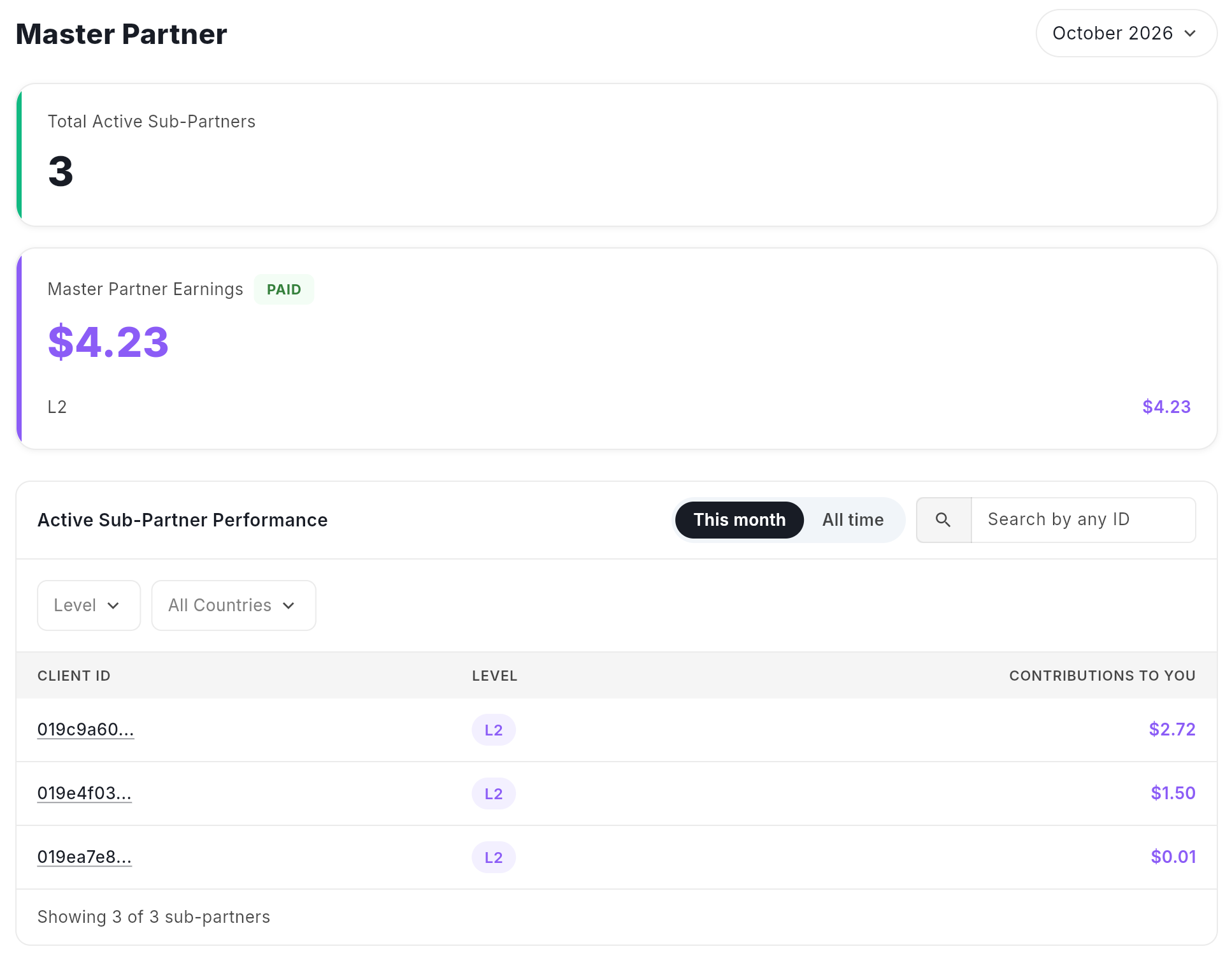
Illustrative figures only — not verified or representative of typical earnings.
The Master Partner report helps you review contribution data. Keep a separate, privacy-conscious tracker to monitor the account references and activity you can see over time.
A practical recruitment workflow
- Choose the audience your partner-content page or post is designed to reach
- Create one clear resource that explains the direct 7.5% Master Partner structure accurately
- Publish your Master Partner link in the placements that fit your existing content and community
- Review the Partner Hub monthly for active-sub-partner and contribution data
- Update your tracker with the account references and activity visible in the report
- Improve your content and resources based on the type of partners who become active
This approach does not guarantee that every sub-partner will become active. It helps you publish the opportunity in relevant places, monitor what you can see, and improve your support resources over time.
Next step: help the right partners get moving
Recruitment is only the start. Once a direct sub-partner joins, the most useful support is often practical: clear resources, an achievable first action, and an agreed rhythm for help.

Quiz
FAQs